The case for investing in real assets
Grids and networks that supply power and water, data centres that process bits and bytes of information, mines and quarries that extract copper, iron and uranium, and pipelines that deliver a steady flow of gas. These physical assets form the backbone of the modern digital economy.
According to Pictet Asset Management’s research, listed companies that own or operate these essential physical assets have historically generated stable, long-term cash flows, underpinning predictable and growing dividends across market cycles, and shielding against economic volatility.
Such companies can therefore play three core roles in a global equity portfolio: providing a diversified source of returns, a degree of inflation protection and the potential for long-term capital growth and income.
Owners of irreplaceable assets often benefit from structural barriers to entry, including local monopolies or regulated market positions. Just as it is impossible to build another international airport next to Heathrow, Changi or Zurich, existing mines and quarries face little threat of competition, thanks to geology, permitting constraints and high transport costs.
Crucially, these heavy assets endure. On visits to some of the world’s largest mines, we saw operations that have been running since the 19th century with production secured well into the 2050s. Similarly, power grids, railways and power stations are built to last for decades, easily outliving market cycles. Their value tends to appreciate over time.
These characteristics enable asset-heavy companies to raise prices faster than costs, helping revenues keep pace with, or outstrip, inflation. Strong cash generation gives management teams the flexibility to invest through business cycles, strengthen balance sheets and pursue growth opportunities when competitors are forced to retrench. As a result, these businesses may deliver more resilient earnings, pay stable dividends across market cycles, and provide return drivers that are less correlated with the broader market.
This is especially important at a time when equity markets have become increasingly concentrated around AI themes. Many asset-light tech companies may be in vogue today, commanding premium valuations, but in future they could prove more vulnerable to shifts in market sentiment and further technological disruption.
AI: an energy race
Investors may think of AI as a race for chips and computing power. From Microsoft and Meta to Amazon and Google, hyperscalers are deploying ever more powerful processors. But there is little point in doing so if the electricity, water and energy networks needed to run them are not in place.
The expansion of AI and data centres and the electrification of buildings, transport and industrial processes are boosting demand for electricity. In the US alone, annual electricity demand is expected to rise by nearly 75% in the next 25 years (see Fig. 1).
Fig. 1 - Projected annual electricity demand in the US, TWh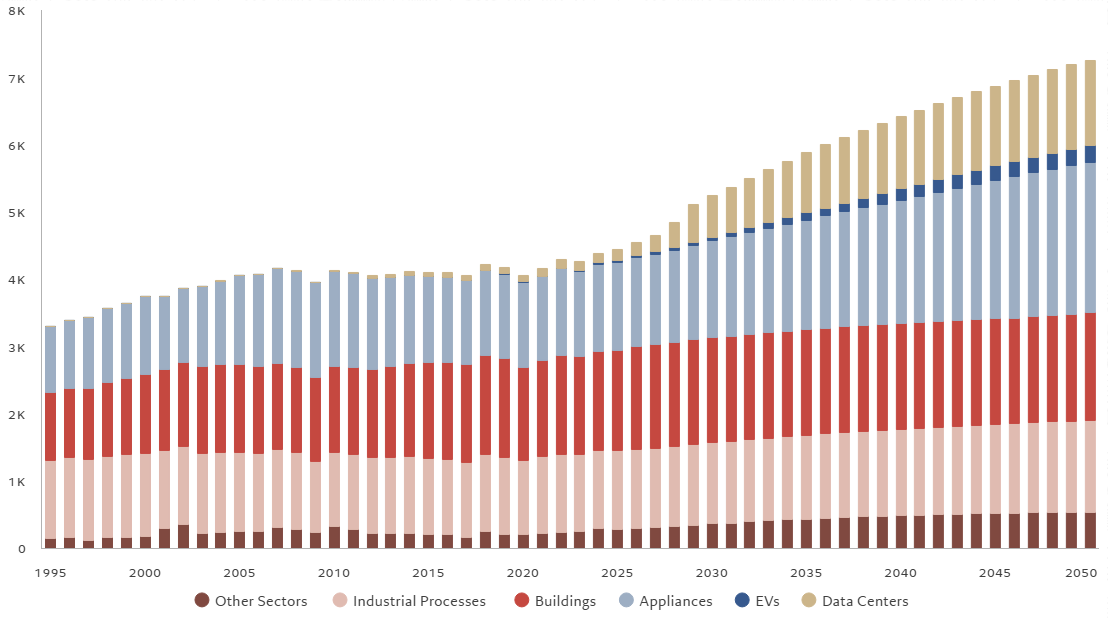
Source: Thundersaid Energy, May 2026
Owners and operators of essential, capital-intensive assets that support the underlying systems for the digital economy are likely to benefit from rising demand, reliable cash flows and stronger earnings growth. What’s more, real assets offer real dividends, which rise with inflation.
Take Southern Co, the second largest US utility serving 9 million customers from more than 100 power generation and transmission assets across Georgia and the Southeast.
Southern enjoys some of the highest levels of sales growth in the US utility industry today, thanks to an expanding population, rising demand from industrial customers, and an influx of power-hungry data centres built by companies such as Google, Meta and Microsoft. Southern raised its outlook for annual sales growth through to 2030 to 10%, compared with its planning estimate of 1% in 2021.
As a regulated utility, it benefits from building new generation and transmission capacity to fulfil this AI demand, and then setting tariffs to deliver a return on that capital expenditure. Georgia’s favourable regulation means that historically those returns have been above average for US utilities.
Southern has paid a consistent dividend since 1948, and has increased it for 25 consecutive years, most recently in April 2026.
In contrast to a regulated utility, Constellation Energy, the largest nuclear generator in the US, sells its electricity into the grid at market prices. Data centres have changed that business model as they seek direct supply, which they are willing to pay a premium for it. Constellation Energy has recently signed 20-year deals with Meta and Microsoft, improving both earnings growth prospects and the visibility of that growth.
Re-industrialisation & reshoring
Major economies are on a reindustrialisation drive, following a series of supply chain shocks in recent years, with causes including the pandemic, trade tensions and multiple wars.
As they bring industrial production back within their borders, they are embarking on capital‑intensive projects that require investment in the physical infrastructure needed to support modern production and supply chains. For example, Taiwan’s TSMC is investing USD 65 billion to build the first three of its planned six new semiconductor fabrication plants in Arizona as part of the US reshoring drive.
Quarries and specialised facilities to produce raw materials, airports, toll roads and other transport links to move goods, and logistics warehouses to store them also underpin the process of reindustrialisation.
Quarry operators such as Heidelberg and Vulcan are local monopolies which produce aggregates – crushed stone, sand and gravel used in construction – and building materials. Their strong market positions allow them to increase prices by mid-single digit percentages every year, whatever the cyclical outlook. This enables regular dividend increases ahead of inflation. Vulcan raised its dividend by 6% and Heidelberg by 9%.
Salik, the exclusive operator of toll gates on Dubai’s road network, benefits from a 49-year concession which underpins its pricing power. Supported by population growth and Dubai’s growing role as a global logistics hub, the company has delivered strong growth, and in March raised its dividend by more than 33%. Other transport infrastructure providers such as Spain’s Ferrovial are also backed by extensive road, rail and airport networks and long-term concessions.
Since 2000, real-asset companies in this universe have raised their total dividend per share by almost 7% on a compound basis (see Fig. 2).
Fig. 2 - Investment universe total dividend per share (DPS), USD, CAGR of +6.8% (2000 to 2025)
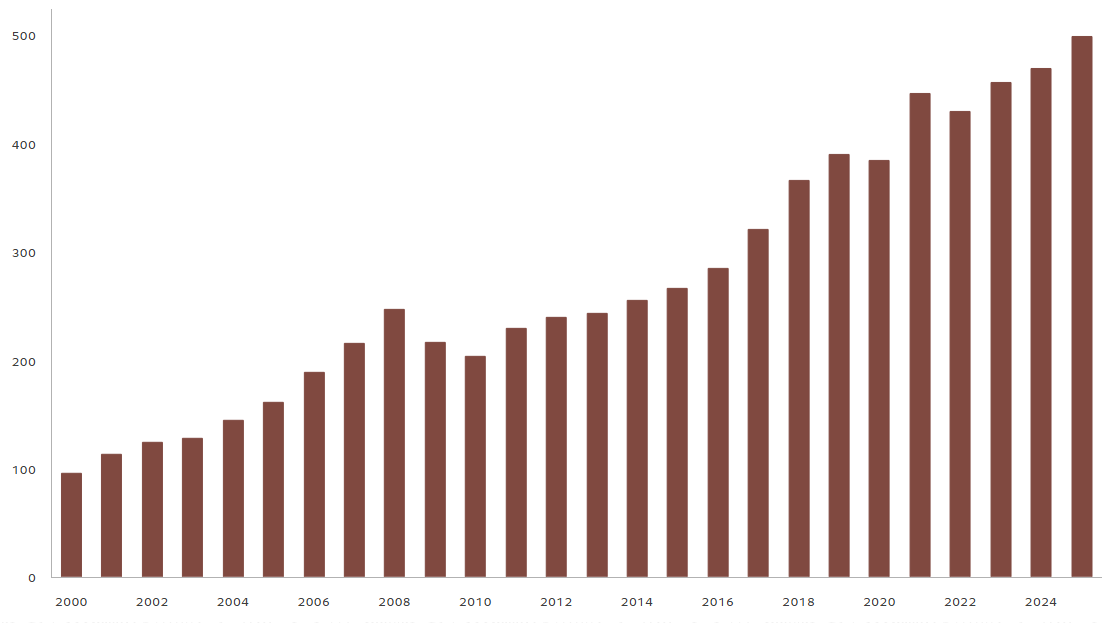
Source: Bloomberg, Pictet Asset Management. Data covering period 0.1.01.2020-31.12.2025.
Real assets for resilience
For many investors, the appeal of tangible assets comes down to their inflation protection characteristics and resilience.
Companies that operate essential, durable infrastructure typically demonstrate strong pricing power. Their revenues are often regulated or contractually linked to inflation, allowing earnings to rise as prices increase. Demand for these services is also highly defensive: paying an electricity bill is not a discretionary purchase even when your budget is tight.
Gold miners offer a different angle. The gold market has historically acted as the go-to inflation hedge for investors thanks to the metal’s finite supply and intrinsic value. Equity investors can gain exposure through the miners. Zijin Gold offers one of the highest production growth rates in the sector, backed by long-life, low production cost mines in South America, Africa and Central Asia, as well as domestic production in China.
All of this translates into returns and dividend income with a degree of inflation protection that is difficult to replicate in bonds or in other areas of the equity markets.
The more digital the economy becomes, the more it depends on physical foundations – assets that are essential to everyday life and cannot be easily automated away or replaced.